HEROSE has developed a new high-pressure globe valve for the transport of gaseous hydrogen. As a safety-critical component in modern GH2 transport systems, it meets the increasing demands of hydrogen logistics.
Demand for hydrogen and transport solutions is growing
Production capacities are expanding and the roll-out of hydrogen infrastructure is progressing. Safe and efficient transport options are needed to supply industry and logistics with hydrogen. Mobile hydrogen transport systems play a major role in reaching consumers who are not connected to a pipeline or production plant.
A systematic approach to project success
Against this backdrop, HEROSE decided to develop an innovative high-pressure globe valve for the mobile transport of gaseous hydrogen. The development took place in close collaboration with a global gas supplier. The valve was specifically designed for transportable pressure vessels and Multiple Element Gas Containers (MEGC). It meets the requirements of EN ISO 10297 (TPED and TPER) and is approved for hydrogen, helium and nitrogen. The valve combines the highest level of leak tightness, maximum operational safety and a robust design for applications up to 500 bar.
Safely managing high pressures
In addition to its in-depth product development expertise, HEROSE has built up extensive practical experience in recent years in handling gases under high pressure of up to 1,200 bar. The new globe valve was designed for an operating pressure of 500 bar at 15 degrees Celsius to meet the highest tightness and safety requirements. “The list of requirements for product-development was demanding and expectations were high,” reports Product Manager Franziska Jänike. Development engineers Daniel Scharr and Tim Fiegel designed valve concepts, on the basis of which HEROSE initially produced the first prototypes.
The new high-pressure globe valve combines maximum safety with a robust design and ease of use.
Franziska Jänike, Product Manager at HEROSE
From prototype to market readiness
Every stage – from the materials and individual components through to prototypes and the finished product – was extensively tested on internal and external test benches. This included, amongst other things, material compatibility tests, leakage measurements using various test gases, including pure hydrogen, burst tests, flame exposure, extended service life tests and climatic testing. The standards applied exceeded the regulatory requirements in order to ensure uncompromising performance. The final type-approval test was subsequently successfully completed at the Federal Institute for Materials Research and Testing. The result of this development process is a high-pressure globe valve specifically designed for use with hydrogen, which performs reliably. Extensive service life tests involving 10,000 complete pressure cycles confirm that it is designed for long-term use and demanding continuous operation on Europe’s roads.
HEROSE Type 01C07 Globe Valve
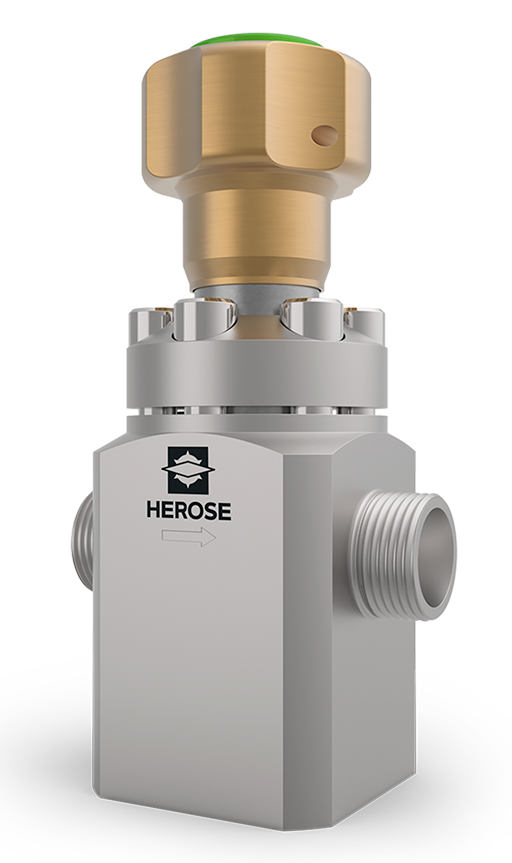
You can find more information about the High-Pressure Globe Valve here.
From development to the road
The first high-pressure globe valves were delivered at the end of June. Various suppliers will be using the HEROSE high-pressure globe valve in their transport systems – the demand is there. The Type 4 pressure vessels used in the transport systems are characterised by a metal-free, weight-saving design. They consist of a seamless plastic inner vessel – the liner – which ensures gas-tightness, and an outer shell made of carbon-fibre-reinforced plastic, which absorbs the pressure and provides external stability. Compared to steel tanks, Type 4 containers are over 70 per cent lighter; they have a long service life – they do not rust – and they are suitable for high pressures, which has made them the standard for hydrogen storage, both as tanks for fuel cell vehicles and as storage units for hydrogen transport.
Extensive leak tests
Leak tests on Type 4 tanks are usually carried out using nitrogen, which means that the tanks must subsequently be purged in order to achieve the required purity of the hydrogen. For most transport operations, “fuel-cell grade” is the purity level targeted, so that the hydrogen refuelling network can be supplied and the requirements for use in fuel cells are met. Other demanding customers, such as the semiconductor industry, also require this level of purity. The process of flushing out nitrogen and replacing it with hydrogen is time-consuming and resource-intensive. Flushing can also place a strain on the tank, as excessively low pressure inside the tank can damage the liner.
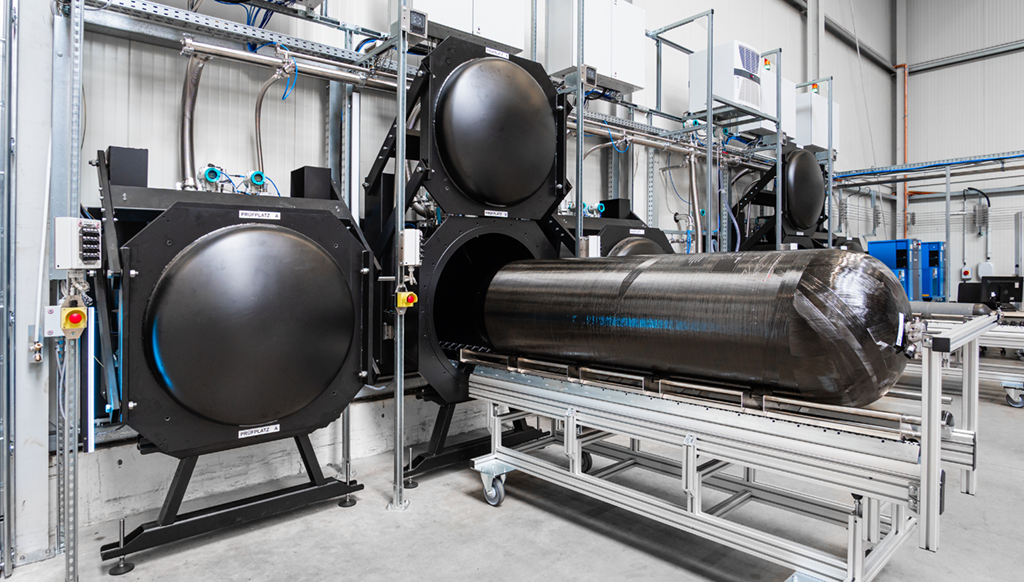
A modular hydrogen distribution system with flexibly configurable pressure connections and integrated flow and pressure measurement technology.
A new solution using vacuum technology
Flushing during initial commissioning and following all inspection and maintenance work involves a significant investment of time and money. The company HYKONIS has developed a patented method to reduce this effort. The idea: to alter the atmosphere so that there is no longer any pressure difference, and to test the vessels directly for leaks using hydrogen. The pressure vessel is placed in a vacuum chamber and a fine vacuum is created. This allows all foreign gases to escape and eliminates any moisture. The vessel is then slowly filled with hydrogen. As there was nothing in the vessel apart from a vacuum prior to filling, the desired purity is achieved. HEROSE’s high-pressure globe valves will be fitted to HYKONIS’s GH2 transport systems, which utilise this patented method.
Sealing hydrogen safely and reliably at all times under high pressure and extreme temperature differences was the major challenge.
Daniel Scharr, Development Engineer at HEROSE
An innovation with compelling advantages
A single tank on the HYKONIS GH2 transport system has a capacity of 625 litres and a kerb weight of 189 kilograms. On these systems, eight tanks are always grouped together to form a section with a volume of 5,000 litres. Depending on the system size, between approximately 500 and 1,200 kilograms of hydrogen can be transported. Each section has its own high-pressure globe valve, which serves safety purposes and enables cascading filling and unloading – this saves on compressor power and allows operation using the necessary pressure drop. The HYKONIS solution is unique worldwide and allows for inerting by means of a vacuum and pressure testing using hydrogen, the medium to be transported. “In everything we do, we focus on maximum safety and the total cost of ownership,” emphasises HYKONIS Managing Director Marius Koch. As a subsidiary of the engineering services provider EDAG, the company has access to extensive expertise and the relevant development capabilities.
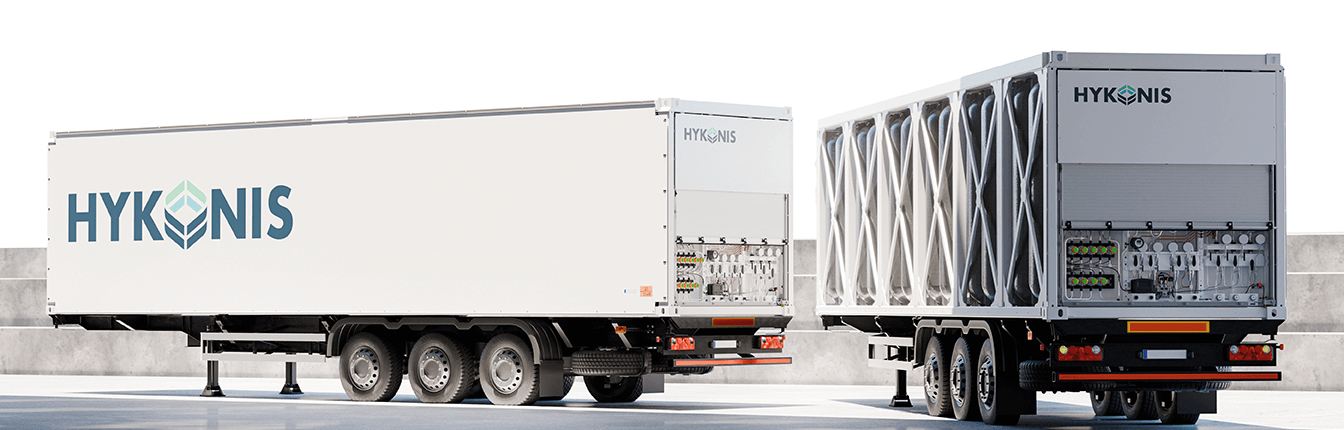
HYKONIS’s new GH2 trailer design sets new standards for the safe and efficient transport of gaseous hydrogen.
A versatile energy carrier
The starting point for all hydrogen trailers is always an electrolyser or a steam reforming plant, where the hydrogen is produced. The GH2 transport system is typically used to supply customers located 100 to 200 kilometres away with gaseous hydrogen. The number of customers, including industrial plants and petrol stations, is constantly growing – and this is joined by airports and ports, which power heavily used vehicles with hydrogen. Hydrogen can also be used as an energy source in the facilities of major bakery manufacturers. Specially developed ovens enable an innovative, resource-efficient and forward-looking baking technology. You wouldn’t know it to look at the breakfast rolls
if the oven in which they were baked reached its temperature thanks to hydrogen – and if the hydrogen was transported there via the new HEROSE high-pressure globe valve.

HYKONIS offers innovative solutions in the field of hydrogen logistics and develops state-of-the-art Multiple Element Gas Containers (MEGCs) for hydrogen transport.
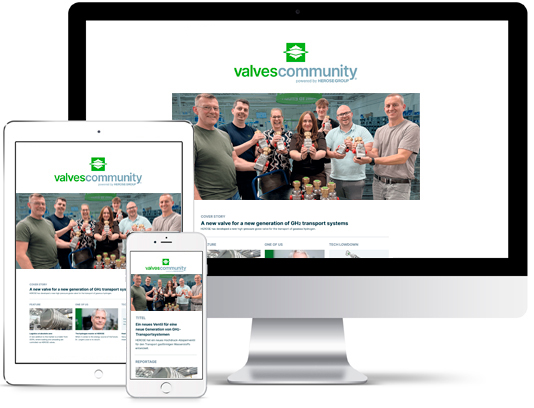 Read the current digital customer magazine now!